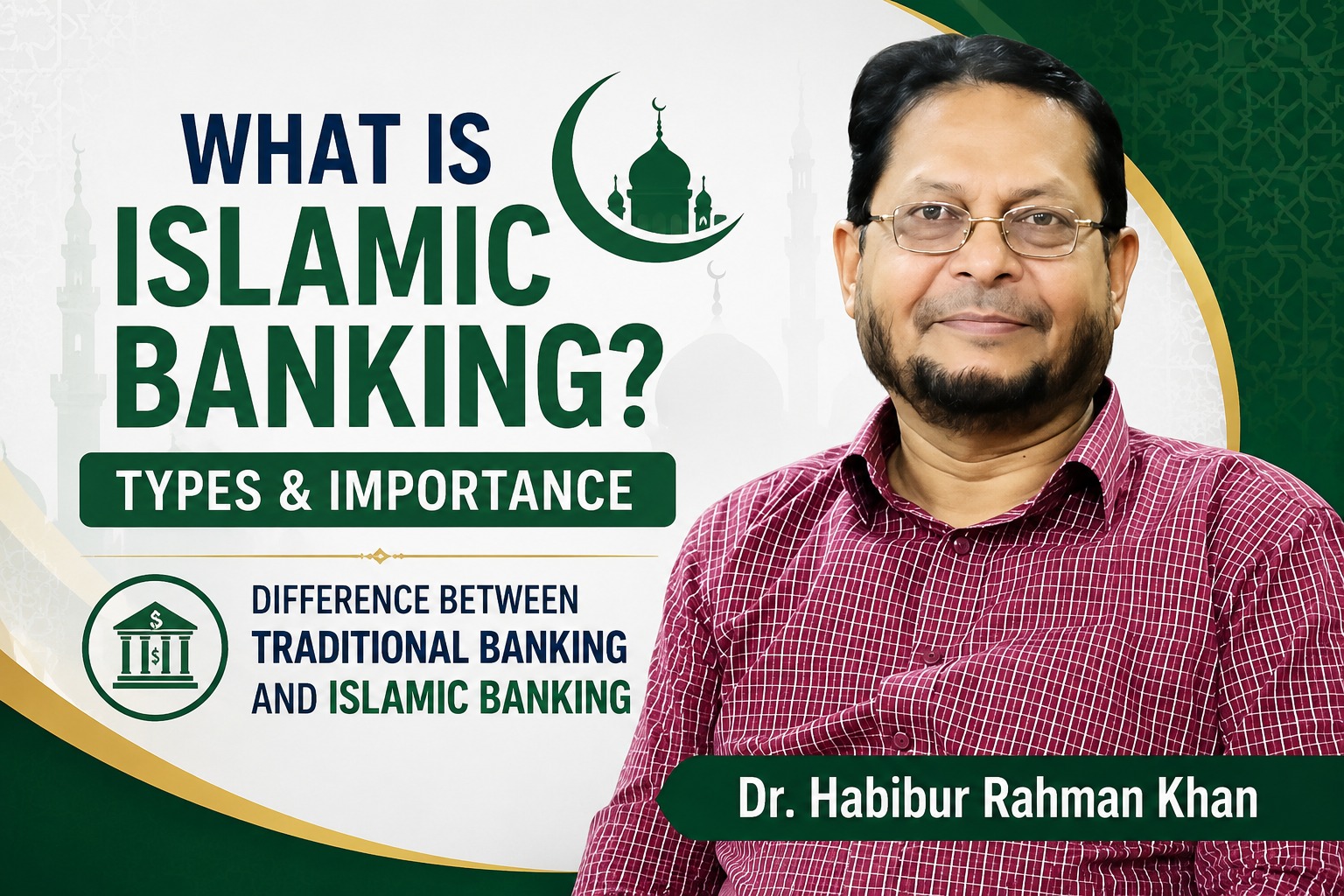
What is Islamic Banking? Types and importance of Islamic Banking. Difference between Traditional Banking and Islamic Banking’ Dr. Habibur Rahman Khan
 Islamic banking is a system of finance that operates according to SHARIA (Islamic Laws), core
principles including the prohibition of interest (RIBA), and profit & loss sharing. Instead of
lending money for fixed interest, banks use asset backed trade, leasing, and joint partnerships.
The key principles of Islamic finance are RIBA free financing, transparent contracts, avoidance
of speculation ethical investment screening, asset connection, risk sharing, and social
responsibility. These principles guide Islamic Banking products such as Musharakah,
Mudarabah, Murabahah, Ijarah, Sukuk, and Takaful.
Over the past four decades Islamic Banking has firmly established itself as a significant financial
sector in Bangladesh, operating in accordance with Islamic principles and providing a secure
platform for transactions.
However, like broader banking sector, Islamic Banking currently faces a range of challenges. The
S Alam Group has caused sustainable damage to Islamic Banking, particularly ISLAMI BANK,
which has suffered the most. In response, Bangladesh Bank is providing liquidity support to help
these banks endure, and there are emerging signs of recovery. Islami Bank has already
navigated much of the crisis, and other Islamic banks are also on the path of recovery. However
the 7 principles of Islamic Banking are (i) Profit and Loss sharing, (ii) Shared risk, (iii) Prohibition
of Riba, (iv) Avoidance of Gharar, (v) Prohibition of Maysir/Gambling, (vi) Prohibition of
investment of unlawful industries, (vii) Paying Zakath to fulfill social responsibility.
Types & Importance of Islamic Banking:
A. Participatory modes: (i) Mudarabah, (ii) Musharakah, (iii) Diminishing Partnership.
B. Sale modes: (i) Murabahah, (ii) Istisna, (iii) Salam.
C. Rut based modes: (i) Ijarah (leasing), (ii) Tawaruq, (iii) Wadiah, (iii) Sukuk (Islamic
Bonds).
Mudarabah: Mudarabah is a profit sharing partnership in which one party provides capital and
the other provides the management. This contract is open described as a sleeping partnership
because the investor does not run daily operations. The investor accepts business risk in
exchange for a share of actual profit.
A Mudarabah contract works by separating the contribution of capital from the contribution of
management. (a) Rab ul Maal provides the capital. This party may be an individual, a group of
investors, or an Islamic financial institution. (b) Mudarib brings commercial skill, it manages the
business venture. This party identifies the opportunity, conducts operations, and applies
expertise.
Musharakah: Mushrakah is a financial contract meaning ‘partnership’ or sharing. Two or more
partners pool their money or work together for a business or property. They split profits based
on an agreed ratio, but they must share loses strictly based on how much money each person
put in.
Main types of Musharakah: (i) Permanent: This partnership continues for the whole life of the
business. (ii) Diminishing: One partner (like a bank) slowly sells their share to the other partner
(like a home buyer) until the buyer owns 100%.
Core rules of Musharakah: (i) Profit sharing: Set by a prior agreement. It does not have to match
the capital split. (ii) Loss sharing: Matches the exact money contribution percentage. (iii)
Management: Partners can all work, or one can be a silent partner.
Diminishing Partnership: Diminishing Partnership/Declining/Musharakah/Mutanaqirah is a
shariah complaint co ownership arrangement in which the financer and client jointly own an
asset, and the client gradually buys the financer’s share over time.
Types of Diminishing Partnership: (i) Shirkat al Aqb: It is a joint venture partnership where two
partners start a business to earn profit, and one partner undertakes to purchase the other
partner’s share gradually. (ii) Shirkat al Milk: It means joint ownership of a specific asset. Two
parties jointly purchase an asset, and one party gradually purchases other’s share.
Murabahah: It is a Shariah compliant time ‘cost plus’ sale. Instead of lending cash with interest
(riba), an Islamic Bank buys a specific asset (i.e. car) and sells it to the customer at a higher fixed
price, which is paid over time in installments.
How Murabahah works: (i) Asset Request: The customer tells the bank what item he needs (i.e.
car, house, machinery). (ii) Bank Purchase: The bank buys the item from a third party seller and
takes legal ownership and risk. (iii) Resale to customer: The bank sells the item to the customer,
openly stating the original cost and the agreed profit margin. (iv) Deferred payment: The
customer pays the total marked up price back in agreed installments or a lump sum.
Istisna: It means asking someone to manufacture. Istisna is a sale transaction where
commodity is transacted before it comes into existence. It is a contract of sale of specified
items to be manufactured or constructed, with an obligation on the part of the manufacturer or
contractor to deliver them to the customer upon completion.
Key rules and conditions: (i) Clear description: The size, shape, material, and quality must be
fully defined so there is no confusion. (ii) No full payment required: Payment 100% upfront is
not mandatory; payments can be deferred or splits into parts. (iii) Binding after start: Either side
can cancel the agreement before work starts; but it cannot be cancelled once manufacturing or
building begins. Common uses: Housing and Real Estate, Infrastructure, Industrial
Manufacturing.
Salam/Bai Salam: It may be defined as advance purchase of a commodity/product making
advance payment by the bank on execution of a written contract wherein it is clearly
mentioned that the commodity will be delivered as per specification, size, quality, quantity, at a
fixed future time in a particular place.
Rules of a valid Salam/Bai Salam contract: (i) Advance Payment: The buyer must pay the full
price when signing the agreement. (ii) Clear details: Both the quality, quantity, size, weight, and
type of the goods must be exact, so there is no confusion. (iii) Delivery time: The exact date and
place for handing over the goods must be written down. (iv) Allowed items: It works best for
regular goods and farm crops that can be measured and described, not for unique items or gold
and silver spot exchange.
How Banks use Salam/Bai Salam: (i) Farming and Business Support: Islamic Banks use this to
give cash to small farmers or factory workers early so they can buy seeds and tools. (ii) Parallel
Salam/Bai Salam: Islamic Banks open make a second separate contract to sell the future goods
to someone else, which helps them make a profit and manage market risk.
Ijarah: In Islamic Banking Ijarah is a Sharia complaint leasing contract. The bank buys an asset,
such as a car, building, or machine, and lets a customer use it for a set time. The customer pays
rent for using the asset. The bank stays the owner and takes the ownership risk.
Types of Ijarah: There are two types of Ijarah (i) Ijarah al Ayn ( lease of an asset): Renting
physical property like a car, machine, or building. Ownership stays with lessor (the bank). (ii)
Ijarah al Amal (hiring services): Employing a person or a worker for wages, such as hiring a
doctor, lawyer, laborer.
Tawarruq: Tawarruq or reverse Murabaha is an Islamic tool used to give cash to a customer. A
buyer purchases a commodity from a bank on a deferred payment plan and then sells it right
away to a third party for spot cash. This lets people or businesses get money without breaking
the ban on usury (riba).
How Tawarruq works: (i) Bank buys the Asset: The bank buys a real, tradable commodity (like
metals, palm oil) from market for cash. (ii) Deferred sale to client: The bank sells that
commodity to the client on credit at a higher, marked up price, to be paid later. (iii) Client sells
for cash: The client takes ownership and sells the item to a different third party for immediate
cash. (iv) Repayment: The client uses the cash and pays the bank over time.
Wadiah: In Islamic Banking system Wadiah means safekeeping or trust. It is a contract where a
customer deposits money or assets with a bank of safe custody. The bank acts as a trusted
keeper, and the customer can ask for their money/assets back at any time.
Types of Wadiah: (i) Wadiah Yad Dhamanah ( Guaranteed custody): (a) The bank guarantees to
return the full principal amount. (b) The bank has permission to use or invest the funds in halal
ways. (c) The bank keeps the profit for these investments, but may give a voluntary gift (hibah)
to the customer. (ii) Wadiah Yad Amanah (Trustee Custody): (a) The bank only guards the asset.
(b) The bank cannot use or invest the money. (c) The bank is not responsible for loss unless it is
careless.
Sukuk (Islmic Bonds): Sukuk, often referred to as Islamic bonds, are Shariah compliant financial
instruments used to raise capital while adhering to Islamic Law, which prohibits interest (riba).
Instead of debt obligations, Sukuk represent partial ownership in tangible assets, projects, or
investments activities.
Main types of Sukuk: (i) Sukuk al Ijarah: Leased based contracts where investors hold a tangible
asset and earn regular rental payments. (ii) Sukuk al Murabaha: Cost plus sale arrangements
used heavily for short term trade and liquidity. (iii) Sukuk al Musharakah: Equity partnership
joint ventures where profits and losses are shared based on capital or agreed ration. (iv) Sukuk
al Mudarabah: Partnership models pairing a capital provider with an investment manager. (v)
Sukuk al Wakala: Agency based contracts where an agent manages a pool of complaint assets.
(vi) Sukuk al Istisna’a: Project financing investments used to fund manufacturing or
construction. (vii) Sukuk al Salam: Purchase contracts involving advance payment for
commodities delivered at a future date.
Difference between Islamic Banking and Traditional Banking: A. Islamic Banking: (i) Follows
Islamic principles, avoiding interest rates. (ii) Profit/Loss sharing happens between the
customers and the Bank. (iii) Shared risks between the borrower and the lender. (iv)
Investments only in Shariah compliant industries and sectors. Investments in Alcohol, Gambling,
Pork, etc are strictly prohibited. B. Traditional Banking: (i) Interest based lending/deposits. (ii)
The bank pays interests on deposits and makes money on loans. (iii) Risks largely taken by the
borrowers. (iv) No religious investment restrictions.
Conclusions: Islamic banking is a fair and stable system based on Shariah Law. It stops interest
(riba) and uses profit & loss sharing. While it grows fast and helps the economy, it faces
challenges like a lack of standard laws and unified rules. Overall it offers a strong, ethical choice
next to normal banks. A few days ago, chaos was created in the Islamic Banking sectors due to
direct intervention of some overzealous individuals. Some believe the incident was instigated
by a friendly neighbor.
সম্পাদক ও প্রকাশকঃ হারুন-অর-রশিদ
বার্তা সম্পাদকঃ আশিক সরকার
Copyright © 2026 Bporikromanewsbd.com. All rights reserved. প্রিন্ট করুন
 সেভ করুন